Calories Calculator
Enter your information below to generate Calorie targets to maintain, gain, or lose weight. These numbers represent a good starting point but may need to be adjusted to generate the desired response.
After you get your Calorie target, head over to our Macronutrient Calculator to see the macro split between Carbs, Fats, and Protein to achieve your target daily.
Calories in Common Foods
Since the Nutrition Labeling and Education Act of 1990, Calories have been listed on food labels. Subsequent updates have been made in more recent years to include revisions in servings, highlight certain nutrition facts (e.g. added sugar), and so on. [58] However, the effects of nutritional labeling changes along with knowledge of Calorie goals on actual food behaviors is mixed. A full review of the existing data on this topic is outside the scope of this article, but the main takeaway is that food behaviors are far more complex than knowing how many Calories a certain food has per serving, or even how many Calories someone should be eating.
Still, some individuals may benefit from knowing how many Calories are in some of the common foods they consume. In the tables below, we’ll list the Calories and macronutrients of some common foods.
Calories and Macronutrients in Protein:
| Protein | |||||
| Food | Serving Size | Calories per Serving | Protein (g) | Carbohydrates(g) | Fat (g) |
| Eggs (1 whole) | 1 egg | 72 | 6.3 | 0.4 | 4.8 |
| Egg Whites | 1 egg white | 17 | 3.6 | 0.2 | 0.1 |
| Greek Yogurt (2%) | 150g | 140 | 12 | 18 | 2.5 |
| Greek Yogurt (fat free) | 170g | 100 | 17 | 6.1 | 0.7 |
| Chicken Breast | 113g (raw) | 136 | 25 | 0 | 3 |
| Chicken Thigh (skinless) | 113g (raw) | 137 | 22 | 0 | 4.7 |
| Ground Turkey (93/7) | 113g (raw) | 170 | 21 | 0 | 9.4 |
| Salmon | 113g (raw) | 144 | 23 | 0 | 5 |
| Seitan | 113g | 162 | 22 | 13 | 2.7 |
| Soy Protein Isolate | 28g | 95 | 25 | 0 | 1 |
Calories and Macronutrients in Carbohydrates:
| Carbohydrates | |||||
| Food | Serving Size | Calories per Serving | Protein (g) | Carbohydrates(g) | Fat (g) |
| Oatmeal | 40g | 147 | 6.4 | 27 | 2.5 |
| Strawberries | 100g | 32 | 0.7 | 7.7 | 0.3 |
| Banana | 100g | 89 | 1.1 | 23 | 0.3 |
| Broccoli | 100g | 34 | 2.8 | 6.6 | 0.4 |
| Asparagus | 100g | 20 | 2.2 | 3.9 | 0.1 |
| Sweet Potato | 133g | 114 | 2 | 27 | 0 |
| Brown Rice | 40g (raw) | 145 | 3 | 30 | 1.1 |
| White Rice | 40g (raw) | 143 | 2.6 | 32 | 0.2 |
| Black Beans | 40g (raw) | 136 | 8.6 | 25 | 0.6 |
| Lentils | 40g (raw) | 141 | 9.9 | 25 | 0.4 |
Calories and Macronutrients in Fats:
| Fats | |||||
| Food | Serving Size | Calories per Serving | Protein (g) | Carbohydrates(g) | Fat (g) |
| Peanuts | 28g | 161 | 7.3 | 4.6 | 14 |
| Peanut Butter | 28g | 167 | 6.3 | 6.2 | 14 |
| Almonds | 28g | 162 | 5.9 | 6 | 14 |
| Avocado | 28g | 47 | 0.6 | 2.5 | 4.4 |
| Olive Oil | 1 tbsp (14g) | 124 | 0 | 0 | 14 |
What is a Calorie?
Calories are a unit of measure for energy. It is used much in the same way that seconds are used to measure time, and kilograms are used to measure mass. Technically speaking, a calorie (with a lower-case c) is the amount of energy required to raise the temperature of 1 milliliter of water by 1 degree Celsius. Our food contains thousands of times more energy than this, so rather than using the term “kilocalories” when measuring the energy in food, this term has been abbreviated as Calories with an upper-case C. [1] So when someone asks, “Is a Calorie a Calorie?” The answer is, “Yes!” It’s just a unit of measurement!
Of note, researchers and professionals in the nutrition field are faced with a problem- neither the Calorie nor calorie are used in the International System (SI) for measuring energy. Instead, the joule (J) and kilojoule (kJ) are the SI units for measuring energy, where 1 joule is the amount of work done by a force of 1 newton (N) moving an object 1 meter in the direction of the force. In many countries, foods are labeled in kiloJoules and not Calories. This is also true of some research papers.
That said, we’ll use Calorie for the rest of this article.
How Many Calories Should You Eat Per Day?
The amount of Calories consumed in the day should achieve healthy body fat and muscle mass levels, while also supporting appropriate amounts of physical activity. To achieve all of these goals, an individual’s Calorie intake must be appropriate for their Total Daily Energy Expenditure (TDEE), which is the total amount of Calories used or “burned” in a day.
Total Daily Energy Expenditure (Calories out)
The three components of Total Daily Energy Expenditure (TDEE) are 1) resting energy expenditure, (REE), 2) diet-induced energy expenditure (DEE), and 3) activity-induced energy expenditure (AEE), modeled by the equation:
TDEE = REE + DEE + AEE
The relative contributions to total daily energy expenditure from each of these components are approximately 60% for resting energy expenditure, 10% for dietary induced energy expenditure, and 30% for activity-related energy expenditure. [2]
[If you need help calculating your TDEE, head over to our TDEE calculator tool page.]
Total Daily Energy Intake (Calories in)
An individual’s total daily energy intake includes all of the Calorie-containing substances consumed, i.e. all foods, drinks, and supplements with Calories.
Calories don’t have a clock per se’, meaning that food consumed at night isn’t more likely to cause weight gain than food consumed in the morning, provided total intake over time – in this case, 24-hours- is the same. Instead, food consumed in the evening may result in some temporary water retention and more food retained in the gut overnight, which can result in a higher morning weight compared to eating earlier in the day.
In general, most short-term changes in body weight are due to changes in water weight, which can occur due to recent exercise as well as recent changes in fluid and sodium intake, dietary pattern, stress, bowel movement frequency, and more. Still, the sum of these effects are not changes in tissue mass (e.g. muscle or fat), but rather changes in water.
Energy Balance
Energy balance describes the relationship between the total number of Calories consumed compared with the number of calories burned through metabolism and physical activity. In an energy surplus, a person will gain weight, when energy in matches energy out a person will maintain weight, and in an energy deficit, a person will lose weight.
Jargon and acronyms aside, the number of Calories eaten compared to the amount that are used determine body weight and there’s no way around that. The effect of energy balance on body weight change takes place over a longer period of time (e.g. weeks and months, not hours and days). There’s also greater than 5-fold variability in response to the same energy deficit or surplus between individuals, which is mostly attributed to genetics. [3 ,4]
In other words, meaningful, sustainable weight change takes time, and results can vary significantly between individuals.
To determine the appropriate Calorie target to maintain weight using this calculator, we need to know your age, height, weight, and activity level. All of these factors influence energy expenditure as described above in the Total Daily Energy Expenditure section. Their contributions can be modeled through the Mifflin-St. Jeor equations.
| Mifflin-St. Jeor Energy Expenditure Equations | |
| Men | (10*(weight/2.204))+(6.25*(height*2.54))-((5*age)+5)*activity factor |
| Women | (10*(weight/2.204))+(6.25*(height*2.54))-((5*age)-161)*activity factor |
The remaining variable, activity factor, serves as a multiple for the individual’s resting metabolic rate that is calculated by the formula. Presently, there’s active controversy surrounding how-to select a specific value because various components of energy expenditure, including activity-related energy expenditure- tend to adapt and reduce their energy use in response to dieting and even long-term exercise.
For example, the constrained energy model posits that humans and other animals share a set of evolved mechanisms to maintain TEE within a narrow range, dynamically compensating to changes in physical activity to keep daily expenditure in check [5] On the other side, the additive energy model suggests that increased physical activity has its own energy or Calorie cost, and this energy is “added” to the total energy expenditure the individual had before undertaking an exercise program.
As of this writing, the answer is somewhere in the middle. With long-term exercise, there seems to be some reduction in energy expenditure from other elements of metabolism that overall reduces the amount of “extra” Calories being burned during exercise, and results in only modest changes to total daily energy expenditure. [6,,7,8, 9,10,11,12,13] This amount of change varies between individuals. [14]
Still, we have to figure out a way to determine an appropriate activity factor, e.g. low, medium, or high. We’ve developed the following quiz to help:
- How many steps per day do you average?
- <5000 (1 point)
- 5000 to 8000 (2 points)
- > 8000+ (3 points)
- How many days per week do you exercise (lift weights, do cardio, play sports) for more than 30-minutes?
- < 3 days (1 point)
- 3 to 5 days (2 points)
- >5 days (3 points)
- At work or school, how active are you?
- Mostly sedentary. Not very active (1 point)
- Moderately active (2 points)
- Very active (3 points)
- Scoring
- 4 points or less= light
- 5-7 points= medium
- 8+ points= high
- *Please note that high levels of recreational and/or occupational activity (or lack thereof) should be considered as exercise for this calculator.
Using the formula in this calculator and the information above, we’ve now predicted the number of Calories you need to maintain your weight. From there, we can add Calories if you want to gain muscle, reduce Calories if you want to lose weight, or keep things the same for maintenance. We’ll discuss each of these options in more detail below, but this guide may be helpful for figuring out what you should do.
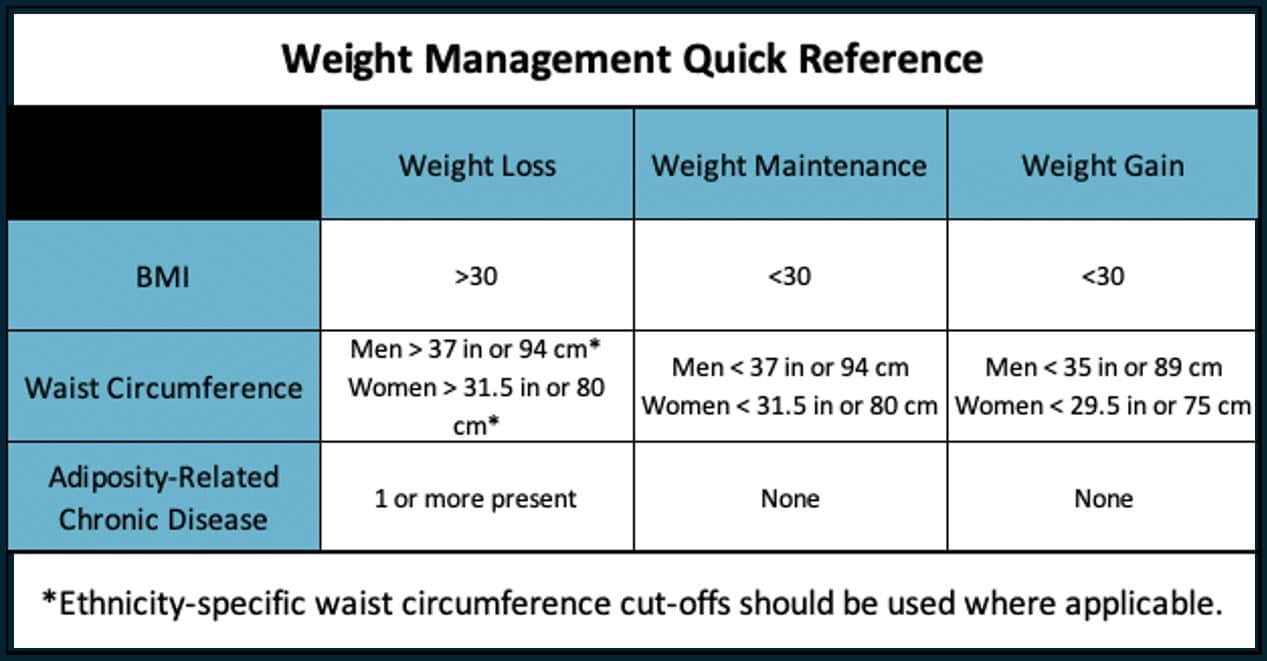
In the table above, BMI stands for Body Mass Index and is calculated by dividing the mass of the individual by their height squared. Waist circumference should be measured at the uppermost outside border of the hip bone, with the measuring tape being parallel to the floor and pulled taught. We go into more detail about waist circumference in this article.
Calorie Intake For Weight Maintenance
For those who do not have a clear health-related reason to lose weight (or who don’t want to), and who do not desire to gain weight, weight management is mostly a personal choice. An individual may also have a health concern that is independent of their body weight and make dietary modifications targeted towards their specific health concern. Aiming to maintain weight can also be useful during periods where motivation for behavioral change wanes or stress levels are high. This calculator provides a predicted Calorie target for maintaining weight.
For individuals who start lifting weights during periods of weight maintenance, we can expect simultaneous increases in lean body mass and reductions in fat mass, especially in those individuals with obesity or who are untrained. [15,16, 17, 18]
Less is known about changes in lean body mass during periods of maintenance compared with a calorie surplus in well-trained lifters. Given that larger calorie surpluses produce greater increases in both lean body mass and fat mass when compared to smaller calorie surpluses in trained populations, we expect lower amounts of change in both parameters when consuming maintenance-level Calories.
Calorie Intake For Weight Loss
Weight loss is recommended for individuals with an obesity-related health concern or for individuals who desire to lose body fat and have no contraindications, e.g. are pregnant, have untreated eating or psychiatric disorders, and so on. [19] This calculator creates a 300 Calorie deficit for those desiring weight loss, which is likely to work well for many, though it is admittedly an arbitrary amount.
Unfortunately, many “rules” pertaining to weight loss are either made up or otherwise arbitrary. For example, the 3500-Calories-in-a-pound rule has been around since the 1950’s, yet is not supported by any real research [20] Instead, evidence has accumulated showing that weight loss occurs in a bi-phasic manner where an initial, relatively rapid phase of weight loss occurs in the first few weeks (mostly water weight), followed by a slower, more gradual weight loss phase that lasts up to ~ a year until weight loss plateaus (mostly fat, hopefully). [21, 22]
Yes, larger deficits are likely to produce greater weight loss results than smaller ones, particularly in the short term. They also have similar levels of success with achieving and maintaining clinically significant weight loss, defined as weight loss in excess of 5% of an individual’s starting body weight sustained for a year or longer. [23] Still, faster weight loss from larger deficits seems to result in more lean mass loss, which may be a concern in trained, performance-minded individuals. Therefore, we selected a more moderate deficit of -300 Calories in this calculator. Individuals may increase the deficit higher if they prefer.
Overall, weight loss depends on a sustained Calorie deficit for weeks to months, as an individual’s average intake over weeks and months is more predictive of weight change than a single day. We recommend that individuals use a modest energy deficit of ~ 300 Calories to start with a weight loss rate of ~ 1 to 2% starting body weight per month.
Calorie Intake for weight gain
Gaining weight is a reasonable goal for individuals without obesity (a BMI of < 30), a waist circumference under the cut-points (<35 for men, <29.5 for women), and who do not have a medical condition related to excess body fat.
We are fairly conservative when recommending weight gain, as it can be problematic when done aggressively or in individuals whose abdominal fat stores expand significantly. Greater Calorie surpluses produce greater amounts of lean body mass with resistance training when adequate protein is consumed. A larger surplus is also accompanied by greater fat accumulation. [24,25]
However, those gaining more muscle mass may not reliably demonstrate greater strength than those who gain less, as the relationship between additional muscle mass and strength is a bit more complicated than that. [26, 27]
Overall, weight gain depends on a sustained Calorie surplus for weeks to months, as an individual’s average intake over time is key. Faster weight gain is likely to produce more fat gain than a slower rate, though individuals can vary significantly based on training, genetics, and more. We recommend a modest Calorie surplus of 300 Calories/day to start and a weight gain target of 0.5 to 2.0 kg per month.
How to Reduce Calorie Intake
We should note that Calorie intake is a complex process that is not primarily under conscious control. We do not consciously “decide” to be hungry, but instead, hunger seems to bubble up on its own and demand our attention. How strongly this is felt and how it influences our behaviors involves a variety of biological, psychological, social, and environmental factors. This can result in an appetite that is either matched or mismatched to our actual calorie needs, regardless of our conscious desires. [28,29,30] With that in mind, we’ll discuss some of our top tips for managing Calorie intake.
Food environment
In human nutrition, the term “food environment” represents what’s available to eat, how desirable a food is, and how convenient it is to obtain it. The food environment is scalable, sometimes referring to the nutrition environment of an individual’s home, school, or workplace, and other times describing the community’s grocery stores, restaurants, and so on. [31]
Over the last 50 years, the food environment has changed in many ways. From the increased availability of tasty, cheap, high Calorie, processed foods, to the larger portion sizes and greater number of meals being consumed away from home, people are eating much differently than they used to. Interestingly, the changes to the food environment coincide with the onset of the obesity epidemic. [32,33]
The “built” food environment of a neighborhood, city, or country includes everything from street vendors and kiosks to restaurants, corner stores, and supermarkets. Short of large-scale policy change affecting the food supply chain, food production, distribution, marketing and more, there’s not a lot an individual can do to change their food environment at large. However, it may be feasible for some to change the nutritional micro-environments they’re exposed to at home and the workplace.
We recommend individuals stock more unprocessed and minimally processed foods like fruits, vegetables, lean proteins, whole grains, etc. at home and in their workplace, while reducing access to foods with added sugar, added sodium, and added fat, particularly those of the ultra-processed variety in order to improve their food environments. Simply put, if it’s not there, you are less likely to eat it.
Eating environment
The eating environment refers to meal-independent factors such as the social setting, distractions and interactions, the effort in obtaining food, and overall atmosphere. [34] These environmental characteristics can interact to influence food-related behavior such what and how much someone eats.
For example, “distracted eating” while using a smartphone or reading a text results in significantly higher (~15%) Calorie intake at a meal when compared to non-distracted eating. [35] Rather than compensating by eating less at subsequent meals, the distracted overeating may persist, thereby leading to a higher Calorie intake than desired. [36]
We recommend that individuals try to consume most meals at home, at the table, without distractions such as a smartphone, television, work-related materials, etc. to help establish a structured eating environment.
Tracking
Most people are unable to accurately judge how many Calories they have consumed, even if they have professional training in the field. One study compared the reported energy intake in 10 registered dietitians and 10 controls. On average, dieticians under reported their intake by 223-Calories per day, whereas the controls under reported their intake by 429 Calories per day. [37]
There also may be differences in under reporting energy intake in individuals with obesity compared to those who are lean, as well as those who are actively losing weight compared to those who are maintaining. [38]
While we acknowledge that many food behaviors are subconsciously driven behaviors associated with the food and environment, tracking food and Calorie intake with a smartphone app or similar may be beneficial for some to improve adherence. This solution is unlikely to be a silver bullet however, as each individual faces unique challenges to weight management. [39]
Prepare meals at home
In the last 50 years, the proportion of calorie intake from meals prepared outside of the home nearly doubled. [40] Based on a decade-old analysis, 41% of adults consumed foods from fast food-type restaurants and 27% from full-service restaurants during the 24 hours prior to the survey. [41] Things are almost certainly worse now with the rise of food-delivery apps.
The problem with food prepared outside of the home is that it tends to result in folks consuming more Calories than they would otherwise have if they had prepared the same thing at home, likely due to hyper palatability, additional ingredients, larger portions, and so on. A 2018 study of 1,418 US adults found that for every additional meal per week consumed from a fast-food or full-service restaurant, BMI increased by 0.8 and 0.6 kg/m2, respectively. [42]
Practically speaking, we recommend preparing the majority of meals at home and reducing consumption of meals prepared outside of the home, particularly fast-food restaurants. To support this goal, learning how-to cook as a way to reduce perceived barriers to preparing food at home and eliminating food-delivery apps may be useful.
Increasing Dietary Protein (up to a point)
Increasing dietary protein is said to increase feelings of fullness or satiety by a number of mechanisms. We’ll cover these mechanisms briefly and weigh-in on whether or not increasing protein intake is likely to help with reducing Calorie intake.
Increasing dietary protein and high protein meals have both been shown to elevate levels of glucagon-like peptide 1 (GLP-1), cholecystokinin (CKK), peptide-YY (PYY) and other hormones that are associated with feelings of fullness. [43,44,45] However, it is not clear whether or not these changes in meal-time hormones from increased protein intake lead to reduced Calorie intake and/or better weight management. In short, this is certainly a plausible mechanism, but it’s not clear this makes a huge difference.
Increasing dietary protein is also said to drive up the Thermic Effect of Food (TEF), which refers to the Calories that are required to digest, absorb, transport, and store energy from food. One way to think about the thermic effect of food is that it represents the energy expenditure increase from baseline within the first 3-4 hours of eating a meal. [46] While higher protein meals do increase TEF, this is only a short-term increase in energy use and there is little evidence that this mechanism reliably produces an increase in total daily energy expenditure, and, if so, improves weight loss outcomes or prevents the development of obesity. [47]
Higher protein intakes have been shown to increase and better support the growth and maintenance of muscle mass, which is the main determinant of someone’s resting metabolic rate. [48] There’s ample evidence supporting this line of thinking up to a dose of ~ 1.6 grams of protein per kilogram of body weight per day. At doses higher than this, there’s unlikely to be additional benefits for muscle mass for most. However, getting to this level of intake does seem like a good idea from both health and performance perspectives.
Other suggested mechanisms include an aminostatic theory, as well as a higher protein diet resulting in a higher level of gluconeogenesis. Unfortunately, neither of these mechanisms have ample evidence in humans showing better weight loss or weight management due to these mechanisms. [50, 51]
Instead, it seems that increasing dietary protein intake likely supports weight loss and weight management by replacing other foods, specifically ultra-processed foods that are highly palatable due to added sugars, added sodium, and added fats. These foods tend to be high in Calories and not very filling, which if displaced by a high protein meal, is likely to help reduce Calorie intake via changing the dietary pattern. Between that and better supporting muscle mass levels, increasing protein intake up to ~ 1.6 g/kg/d seems like a good suggestion for weight management.
Reduce Added Sugars
Added sugars in food refers to sugar that does not naturally occur in the food, but is added during processing, by cooks during preparation, or individuals adding at the table. They are found in a variety of sweetened foods including desserts, fruit juices, breakfast cereals, and many others. Multiple national and international health organizations have put forth recommendations to limit sugar intake, as it’s well established that ultra-processed foods with added sugar tend to increase total Calorie intake owing to the fact that they are high in Calories, very tasty, but not very filling. [52, 53, 53]
The recommendation to limit the Calories coming from added sugars is most applicable to ultra-processed foods, especially sugar-sweetened beverages like sodas, teas, and similar. Sugar-sweetened beverages account for nearly 60% of added sugar consumption in adults. This is problematic because humans typically do not compensate for the Calories contained in these beverages by consuming fewer Calories in their meals throughout the rest of the day, meaning that they’re more likely to eat too many Calories. [54]
We recommend limiting foods with added sugars to less than 5% of daily Calories, with an emphasis placed on reducing or abstaining from sugar-sweetened beverages.
Reduce Alcohol Intake
Similar to sugar-sweetened beverages, humans do not compensate well for the Calories supplied by alcohol, which again can lead to overeating. Another mechanism that is likely at play is known as the aperitif mechanism, whereby alcohol increases the desirability of the food nearby as well as its enjoyment, perhaps leading to over consumption.
For individuals interested in weight loss or who are having a difficult time maintaining weight loss, reducing alcohol intake to 1 to 2 standard drinks per day or abstaining from alcohol intake may be helpful.
Increase Dietary Fiber
Dietary fiber refers to the edible, non-digestible molecules including certain carbohydrates and non-carbohydrate components of plant cells. Fiber content is related to the plant species, part of the plant (leaf, root, stem), and plant maturity. Animal cells do not have cell walls and thus do not contain fiber.
It is well established that dietary patterns higher in fiber are health-promoting, as they increase the diversity of healthy gut bacteria, upregulate anti-inflammatory and anti-cancer effects associated with increased short-chain fatty acid production, and are correlated with improved weight loss outcomes, among many other cool things. [55, 56, 57]
Our recommendation is for individuals to consume at least 30-35 grams of fiber per day, ideally from fruits, vegetables, legumes, and/or whole grains. For individuals who choose to track their macronutrients and/or calorie intake, we recommend counting carbohydrates and calories from fiber. Individuals who are willing and able to consume higher amounts of fiber will benefit even more, so we do not recommend a specific upper limit on intake. For more discussion on fiber, see Episode 109 of the Barbell Medicine podcast.
Explore Other Calculators