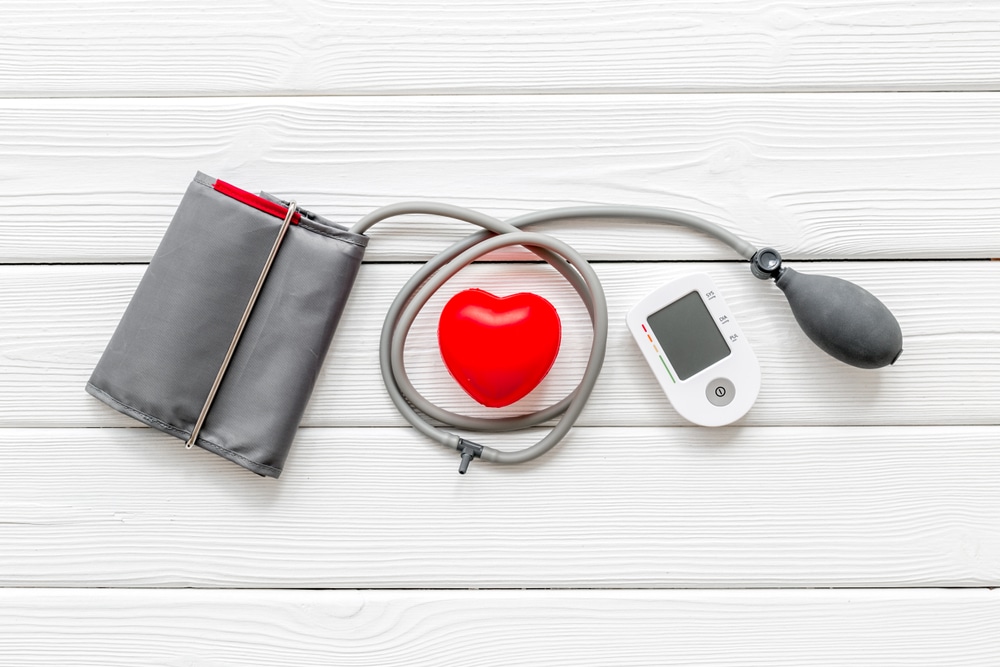
Most people have their blood pressure checked in a healthcare office setting. If this office measurement is high, additional measurements outside the office setting are recommended to confirm before starting treatment. USPSTF 2021
Checking blood pressure at home can be an excellent option, but requires careful technique with the appropriate equipment.
How to Check Your Blood Pressure At Home
The most accurate way to measure your blood pressure at home involves using a validated automatic blood pressure machine under the correct conditions. A list of validated blood pressure devices is available at ValidateBP.org.
First, the blood pressure cuff should be appropriately sized for your arms — a cuff that is too small will give falsely high blood pressure readings, while a cuff that is too large will give falsely low readings. We can correlate the circumference of the upper arm (for example, using a measuring tape around the upper arm) to an appropriate cuff size, as shown in the table below. AHA Fortunately, most devices are now sold with variable-size cuffs that will fit most arms from the “small adult” to “large adult” range.
| Arm Circumference (centimeters) | Arm Circumference (inches) | Recommended Cuff Size (width x length, in cm) |
|---|---|---|
| 22-26 | 8.7-10.2 | 12 x 22 (small adult) |
| 27-34 | 10.6-13.4 | 16 x 30 (adult) |
| 35-44 | 13.8-17.3 | 16 x 36 (large adult) |
| 45-52 | 17.7-20.5 | 16 x 42 (extra large adult) |
Steps to Measure Your Blood Pressure:
When ready to measure your blood pressure, follow these steps. For a graphical illustration, see here.
- Ensure you have a quiet room, a chair with back support, and a table.
- Place the blood pressure cuff on your arm, lining up the artery indicator line on the cuff over the inner part of your upper arm. When using an upper-arm blood pressure device, the lower end of the cuff should sit about 2–3 centimeters (about an inch) above your elbow crease.
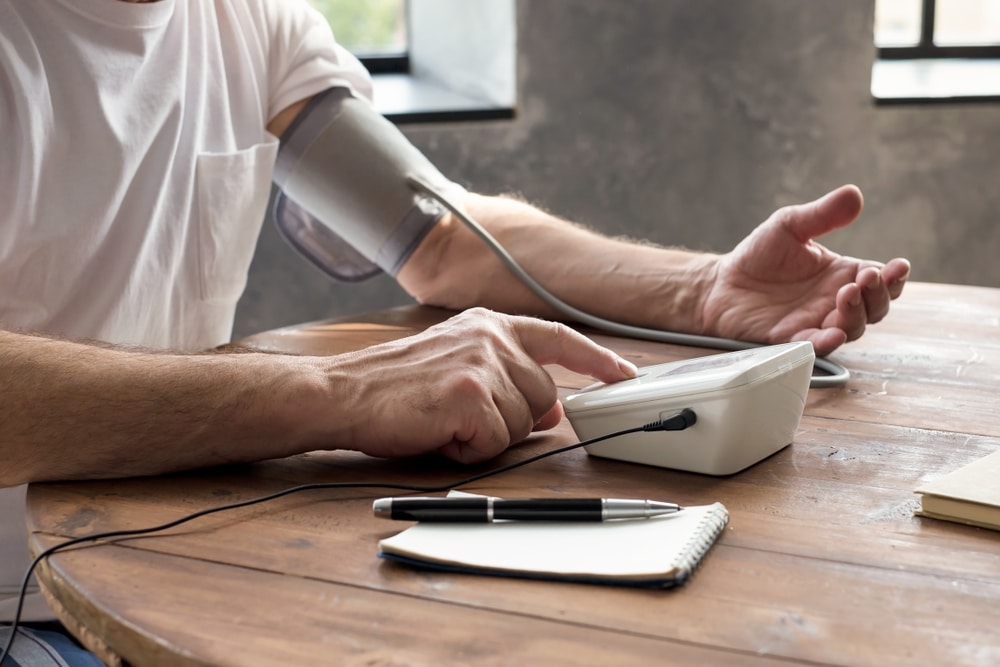
- Rest your arm on an elevated surface, like a table, a box, or a few pillows, so that your arm is at the height of your heart. Ensure your arm is relaxed and your palm is facing upwards.
- Once everything is properly positioned, sit upright with your back supported, legs uncrossed, and feet flat on the floor. Sit quietly for five minutes while remaining relaxed in this position before taking the first measurement.
- Start the machine to have it take your blood pressure while staying relaxed. Repeat the measurement a second time for more reliable results.
How Often Should You Check Your Blood Pressure?
For generally healthy adults without a diagnosis of high blood pressure, resting blood pressure should be checked at least once per year. USPSTF 2021.
If an adult is undergoing evaluation for high blood pressure, they can have blood pressure checked in the physician’s office, but should also have out-of-office measurements performed for confirmation. When evaluating people for high blood pressure using home measurements we recommend a minimum of three days of measurements, two in the morning and two in the evening on each day. Bello 2018
Even if the resting blood pressure measurements are high, this can be addressed gradually over time with a primary care doctor if no other symptoms are present. Emergency care is rarely needed, only in situations where symptoms like chest pain, shortness of breath, vision changes, confusion, or stroke-like symptoms are present, but otherwise can safely be managed in the primary care setting.
Conditions like white coat hypertension and masked hypertension require blood pressure monitoring outside of the doctor’s office. The preferred method is known as “24-hour ambulatory blood pressure monitoring”, where a special blood pressure monitor is worn continuously for 24 hours and a series of measurements are taken automatically as you go about your day. However, properly calibrated home blood pressure machines can be used if 24-hour monitors are not available. Carefully measuring blood pressure as outlined above, twice in the morning and twice in the evening for at least 3 days, can provide useful information to help your doctor make recommendations.
What Is A Good/Healthy Blood Pressure Reading?
In general, a healthy resting blood pressure for most adults falls below 120/80 mmHg.
However, interpreting blood pressure values can be challenging. Sometimes the measurements can be falsely high or low due to problems with cuff size or measurement technique.
It can also be expected and even appropriate for people’s blood pressure to be transiently higher, for example during exercise or stressful situations. Other people live with resting blood pressures much lower than 120/80 mmHg. This can also be normal, especially if they feel well and have no symptoms like lightheadedness, dizziness, chest pain, passing out, or other concerning symptoms. What is most important is the person’s average, resting blood pressure over long periods of time.
For adults who already have a diagnosis of high blood pressure, current guidelines recommend targeting a blood pressure goal of less than 130/80 mmHg, and ideally below 120 mmHg when feasible. This is especially important for people at high risk of heart disease, stroke, and other complications. It is not always wise or feasible to target the lower numbers in all patients, depending on side effects of medicines, life expectancy, and other considerations.
When Should You See a Doctor?
In general, if your resting blood pressure is above the goal range without any symptoms like those mentioned above, you can work with your doctor to gradually improve it using lifestyle strategies and medications, as outlined in our Guide to High Blood Pressure.
If you are having significant symptoms like those mentioned above along with a significantly high or low blood pressure, it is wise to see a doctor more quickly.